
A story about a talk, a rainy week in northern Thailand, a best friend with a camera, and a number I wish I had never seen. Slides, the dataset and the test card from Chiang Mai SEO Conference 2026 are free at emiliotakas.com/chiangmai.
Seventeen hours.
That is how long it takes to get from Athens to Chiang Mai, door to door, if the connections behave. Somewhere in the second half, with the cabin dark and the little plane on the map crawling across India, you stop pretending you will do anything useful and you just watch it crawl.
I did not open the deck. I know speakers who rehearse in the shower, in the taxi, in the passport queue. I had run through mine a little, enough to know where the door slides were and where the numbers were, and then I stopped. Partly because I am lazy about rehearsing. Mostly because this talk was not something I had to memorise. It was something that had happened to me, and you do not rehearse a story you lived. You just tell it.
Next to me, asleep with his camera bag under his feet, was my best friend.
The friend with the camera
He came for two reasons. The official one is that he is a seriously good photographer and I wanted real photos of the talk, not the three blurry phone shots from the back row that every speaker ends up with. The unofficial one is that we have known each other long enough that a trip to the other side of the world without him would have felt like cheating.
I say this to everyone who travels for work: find the way to bring the people you love along. The work gets better, not worse. You have someone to eat with, someone to laugh at your nerves with, someone who tells you honestly that the second slide is too long. And ten years from now you will not remember the talk. You will remember the week.
We landed on Monday morning, after seventeen hours, into a city that was grey.
A rainy week in a sunny city
Everything you read about Chiang Mai in November says the same thing. Cool season. Clear skies. The best light of the year. The nomads come back from wherever they spent the monsoon, the cafes in Nimman fill up with laptops, and the whole old city, with its square moat and its brick walls and its three hundred temples, sits under a sky you could sell postcards of.
Not this week. From Monday to Thursday it rained. Not dramatically. Just a low grey ceiling and a steady, patient drizzle that turned the moat into a mirror and sent the songthaews, the red trucks that circle the old city all day, splashing through puddles with their tailgates dripping.
My friend took it personally. A photographer in a famously photogenic city, with no light. He spent the week looking at the sky the way I look at a rank tracker. Waiting for something to open.
I thought about that a lot, because the talk I had carried across the world was about exactly that. Waiting for something to open.
The confession I packed with me
I break iGaming SEO for a living. Casino and sportsbook search is the most copied corner of Google there is, and I lose to worse pages every week. So I know the feeling of reading the SERP properly, building the better page, winning by every standard we teach, and then watching a thinner page beat you, and a forum thread from 2014 beat both of you. And then blaming your own execution.
But the real reason I was in Chiang Mai was something I had done eighteen months earlier.
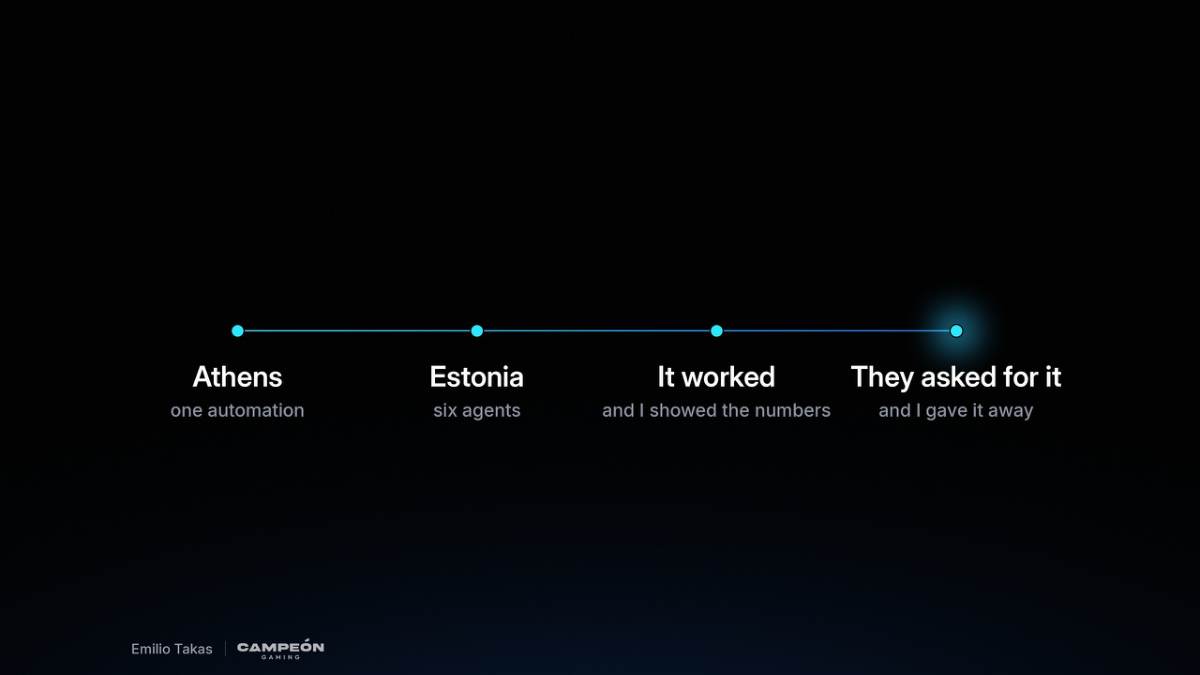
In Athens I built one small automation. It worked. A few months later I stood on a stage in Estonia with six agents instead of one and I showed the numbers. People came up afterwards and asked for it, and I did what speakers do. I gave it away.
And then nothing. Nobody measures what happens after the talk. Not the speaker, not the audience. We clap, we photograph the slide, we fly home and copy it. I had no idea whether my own playbook had helped a single person in that room, and neither did they.
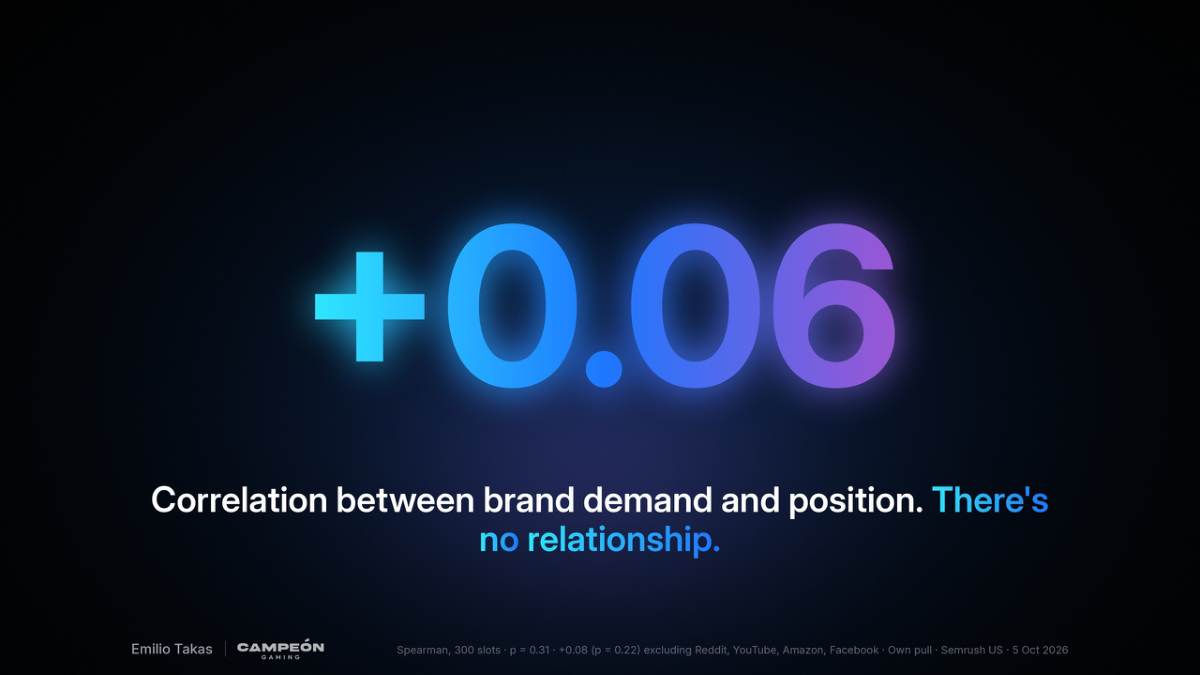
So this year I measured. Not my playbook specifically, but the idea underneath every playbook ever sold: that if you do what the winner did, you get what the winner got. Thirty “best” markets, 300 page-one results, 153 websites, every brand’s monthly search demand, one correlation.
Plus 0.06.
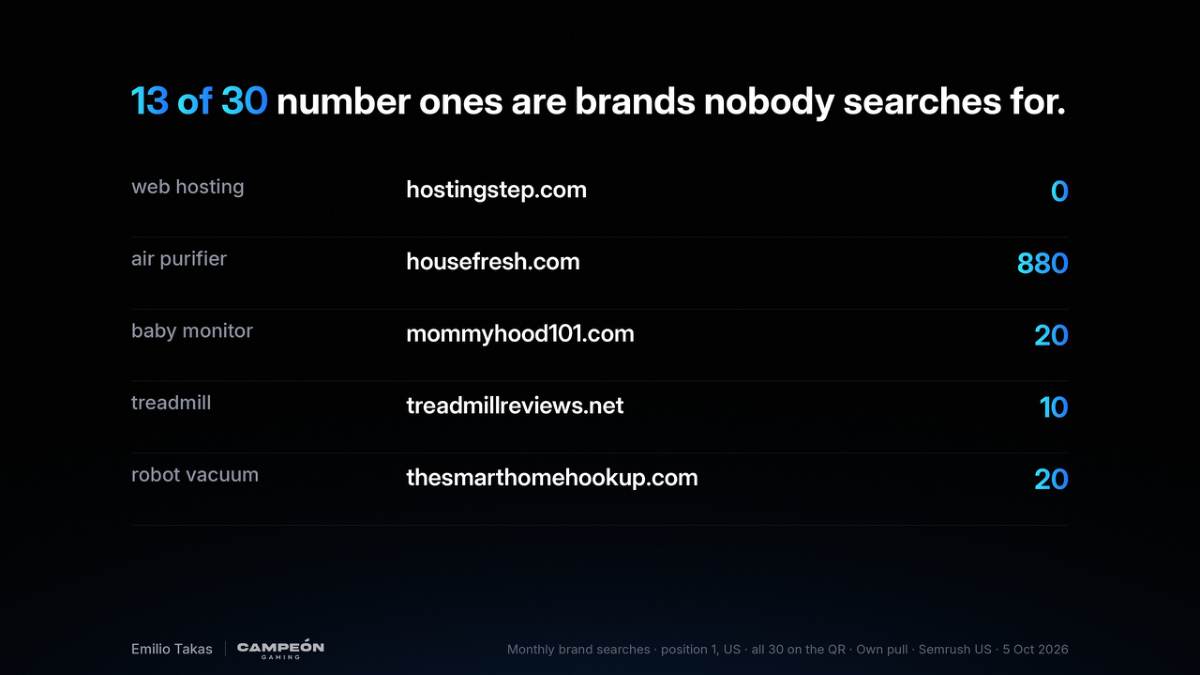
There is no relationship between how famous a site is and where it ranks on page one. Worse, the sign points the wrong way. The median number one has 11,450 brand searches a month. The median number eight has 246,000. Thirteen of the thirty number ones are sites nobody searches for at all. A web hosting site with zero brand searches a month is number one for “best web hosting”.
That is the number I was carrying. Because if being better does not win, and being big does not win, I was about to stand in front of the most tactical room in SEO and tell them what does. And it is not a tactic.
Why this room
Chiang Mai SEO Conference is not a corporate event. Nobody wears a lanyard to impress anyone. It is where the affiliates and the one-person sites and the people who make a living from Google without ever meeting a client come once a year to say out loud what actually worked, and, more rarely, what did not. If you are going to tell people their case studies are survivor stories, this is the room to do it in. They will either agree with you or take you apart, and both are better than polite applause.
So on the morning of the talk, with the rain still going and my friend checking his lenses for the fifth time, I was not nervous about the slides. I was nervous about whether the room would let me in.
You can tell within ninety seconds.
This one did, and it did it the way Chiang Mai does everything, without fuss. When I opened with “your page was better, it lost anyway”, I watched a few hundred people nod before I had said why. They had all lived it.
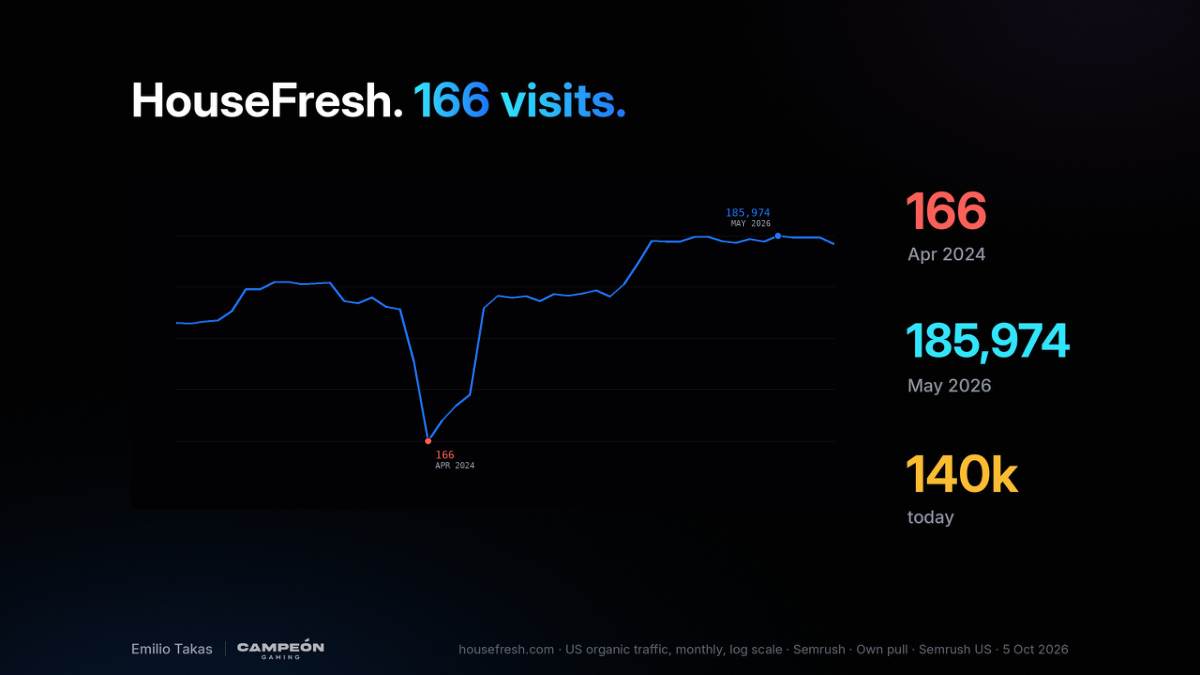
I told them about Forbes Advisor, the biggest affiliate playbook in history, peaking at 15.8 million monthly visits in April 2024 and falling 99.86 percent in nine months. And about HouseFresh, a tiny air purifier site with 166 visits that same month, one hundred and sixty six, which is number one for “best air purifier” today. Same two years. Opposite results. If you had written a playbook in April 2024, you would have written the Forbes one. Everyone did.
I gave them the three reasons copying fails. Case studies only publish what worked; nobody ever sold a course called “here is what didn’t work for me”. There is no control group; 100 six-figure blogs ran the same playbooks for four years, the median lost 85 percent, and 21 grew anyway, which means the playbook did not decide it. And every playbook has a clock on it. It works for one site once, it gets written up a year later by the winner, it becomes a course two years later, and it reaches your feed after the edge is gone.
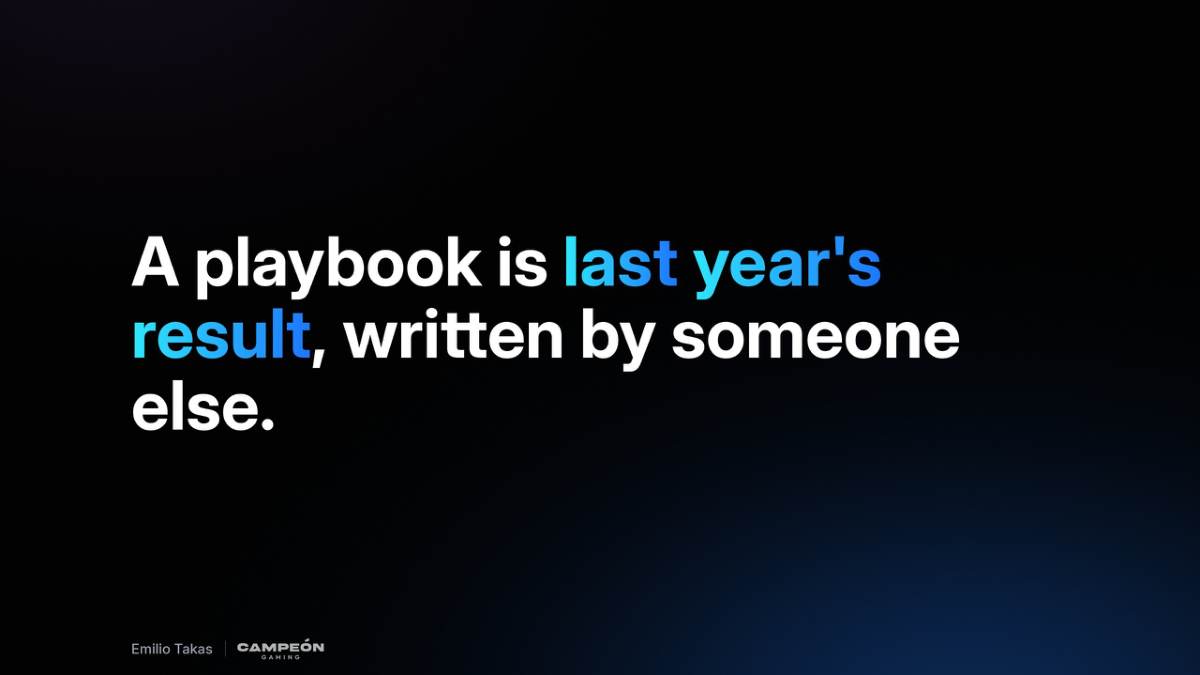
A playbook is last year’s result, written by someone else.
Then I showed them the plus 0.06, and the room went quiet in the good way. The way a room goes quiet when it is doing arithmetic on its own business.
Somewhere to my left, a shutter clicked.
The door
The second half of the dataset is the half that matters, and it is the half nobody publishes because it does not sell a course either.
Ten websites hold 41 percent of page one across all thirty markets. Reddit is on 30 of the 30. YouTube on 29. Twenty four mega brands hold 40 percent of the page; 71 small sites share 26 percent between them. Being known does not decide where you rank. It decides whether you are on the page at all.
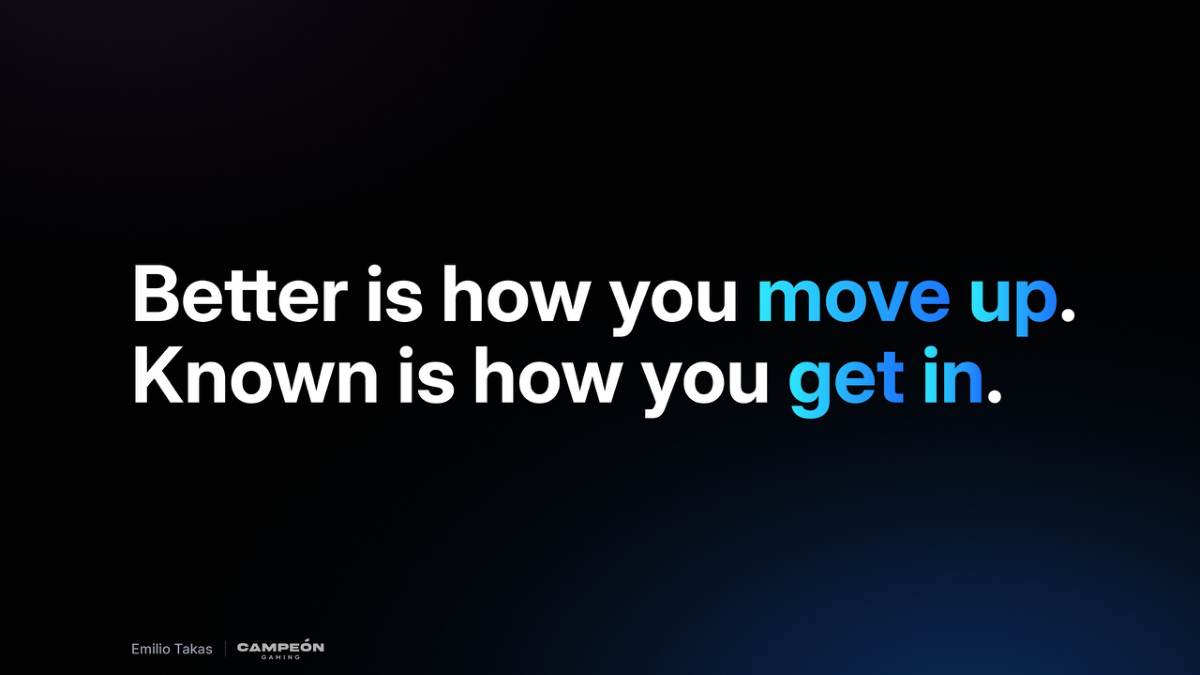
Known is how you get in. Better is how you move up.
Every temple in Chiang Mai has a gate. Not a decorative one. A proper threshold with steps and guardians that you have to consciously step over. You do not drift into a Lanna temple. You decide to go in, and then, in a sense, somebody lets you in. I had built the whole talk around a door and flown it to a city made of them. In the rain, with the gates lit from inside, it was hard to miss.
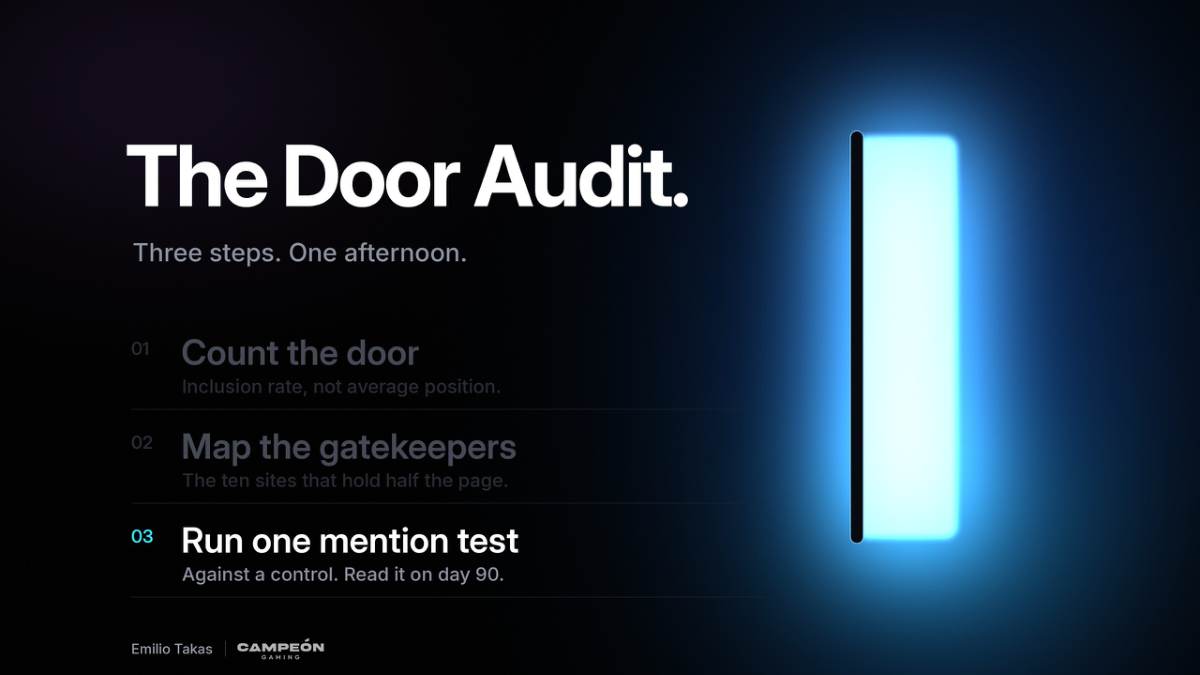
Anyone can fly to Thailand and tell people their playbooks are dead. The useful part is what you do on Monday. So I gave the room a test instead of a tactic, and I called it the Door Audit. One afternoon. Count the door: your 50 target queries, and the share where you appear anywhere in the top ten. Not average position. Inclusion. Map the gatekeepers: the ten sites that hold half the page in your category, because you do not outrank Reddit, you get named on Reddit. Then run one mention test, one podcast or one video or one dataset, against a matched control set you leave alone, and read it on day 90, not before. Up five points over control, fund five more. Under two, stop and log it. In between, extend once.
I put the test card, the dataset, the spreadsheet and every source behind a QR code on the last slide. Free, no email. Partly because that is how Chiang Mai works. Mostly because this time I want to measure what happens after the talk. I can see how many people scan it. In ninety days I will know whether anyone ran it.
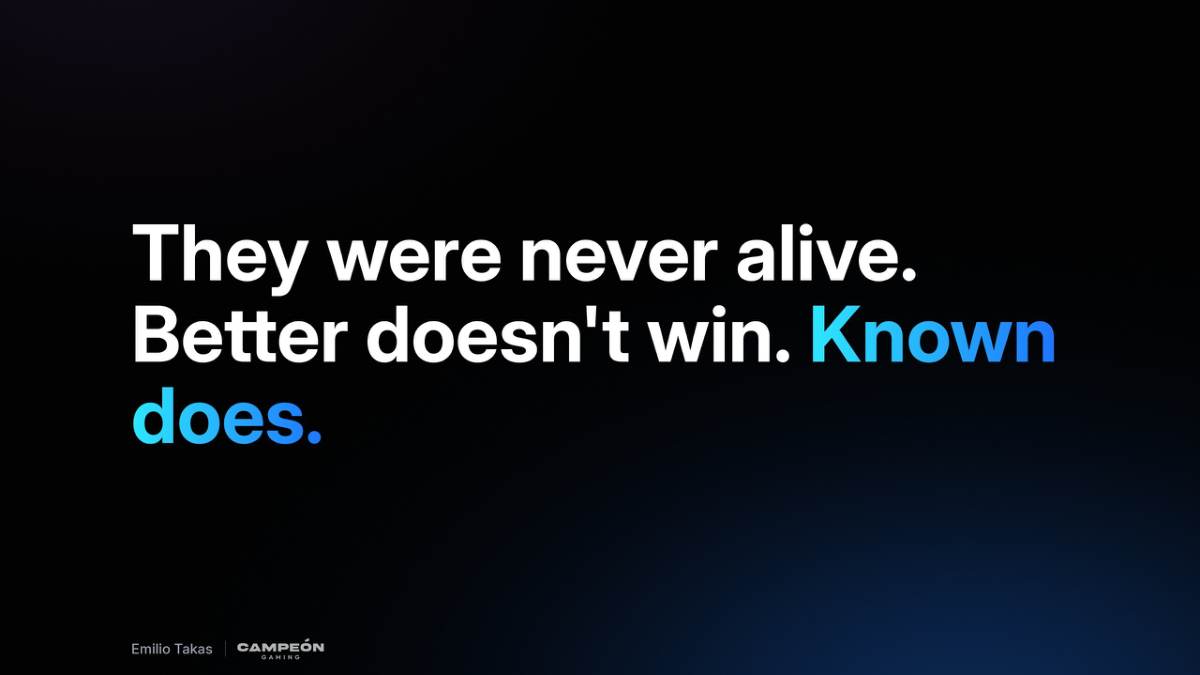
The last slide said thank you in Thai. Khop khun krap. The one before it said the thing I actually believe, which is not quite what the title says. SEO playbooks are not dead. They were never alive. Better does not win. Known does. And then better decides what happens next.
After
The rain did not stop for the talk. It did not stop afterwards either. We went out anyway, the two of us, the way you do when you have flown seventeen hours and you refuse to let a grey sky decide the week for you.
What I will remember is not the stage. It is sitting across from my best friend that night while he scrolled through the photos, a few hundred frames of me under stage lights in a city that would not give him any sun, and both of us laughing at the ones where I am mid-word with my mouth open. He got the light he needed indoors. He found the door.
That is the whole talk, really. Everyone is waiting for the sky to clear. For the algorithm to finally reward the better page. It does not work like that. The gate is already there. Someone has to let you in, and your job is to go and be known by the people who hold it, not to stand outside in the rain polishing your page.
I went to Chiang Mai to give something away again. The difference, this time, is that I am counting.
Now go count your door.

Everything from the talk, the 30-market dataset, the Door Audit spreadsheet with two worked examples, the printable test card, my own e-bike Door Audit and every source with a link, is at emiliotakas.com/chiangmai. Free, no email.